Building WynnWorld Arcade with Phaser
A first-hand look at why I built WynnWorld Arcade, how the collection is structured, and what I learned moving from program management into hands-on browser game development.
Building a place for small games
WynnWorld Arcade started as a way to give small browser-game experiments a permanent home. Instead of putting every idea into one large game, I wanted a collection where each project could test a different mechanic, theme or interaction while still feeling part of the same environment.
I did not come into game development from a traditional game-design background. My earlier career was in program and project management in multinational companies for more than twenty years. After a career transition following a layoff, I began learning modern AI-assisted development and web tools on my own. WynnWorld Arcade became one of the places where that learning could turn into something people could actually play.
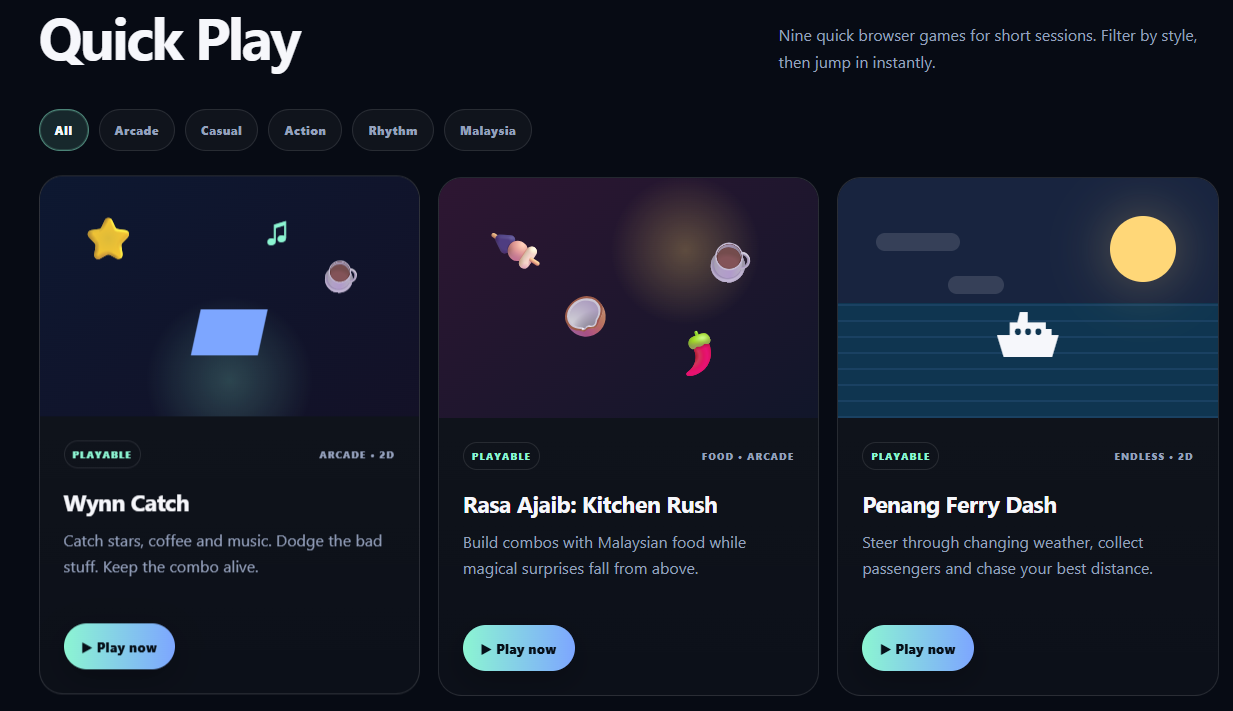
The current collection includes titles such as Wynn Catch, Rasa Ajaib: Kitchen Rush, Penang Ferry Dash, Kopi Stack, Penang Memory Match, Rainy Focus Runner, Wynn Neon Breaker, Wynn Rhythm Tap, Tiny Night Market and WynnWorld: Neon Quest. The goal is not to make every game large. The focus is on experiences that can be understood quickly and played directly in a browser without creating an account.
Why Phaser 3
The games are built around Phaser 3 together with TypeScript, Vite, HTML and CSS. For WynnWorld Arcade, that stack is useful because the finished game can still behave like a normal web application. A player opens a URL and starts playing. There is no installation flow and no login requirement for normal gameplay.
Using the same general stack across several projects also reduces friction when moving from one game to another. The structure is familiar, the production build can remain static, and each game can be deployed independently.
Designing for short sessions
One recurring idea behind the Arcade is quick play. A visitor should not need a long tutorial before understanding what to do. Wynn Catch is built around moving, collecting useful objects, avoiding hazards and improving the score. Kopi Stack focuses on timing and balance. Penang Memory Match uses a familiar card-matching structure. Wynn Neon Breaker explores classic brick-breaker mechanics with power-ups and changing conditions.
These projects do not try to compete by being huge. They try to be clear. That is an important distinction because a browser game has only a few seconds to convince someone that it is worth trying.
Malaysian themes inside browser games
Several games deliberately use familiar Malaysian references. Rasa Ajaib: Kitchen Rush connects the Arcade with the Rasa Ajaib visual project. Penang Ferry Dash uses a Penang-inspired ferry setting. Kopi Stack brings kopitiam imagery into a simple stacking challenge. Penang Memory Match and Tiny Night Market use local visual ideas in different casual formats.
These themes help the games feel connected to WynnWorld rather than looking like unrelated technical demos. They also reflect the broader direction of the site: technology and creative work can still carry a sense of place.
A local player profile without an account system
The Arcade includes a lightweight Local Player Profile. Progress is saved in the browser instead of requiring a server-side account. This allows the experience to recognise milestones across the collection while keeping the entry barrier low.
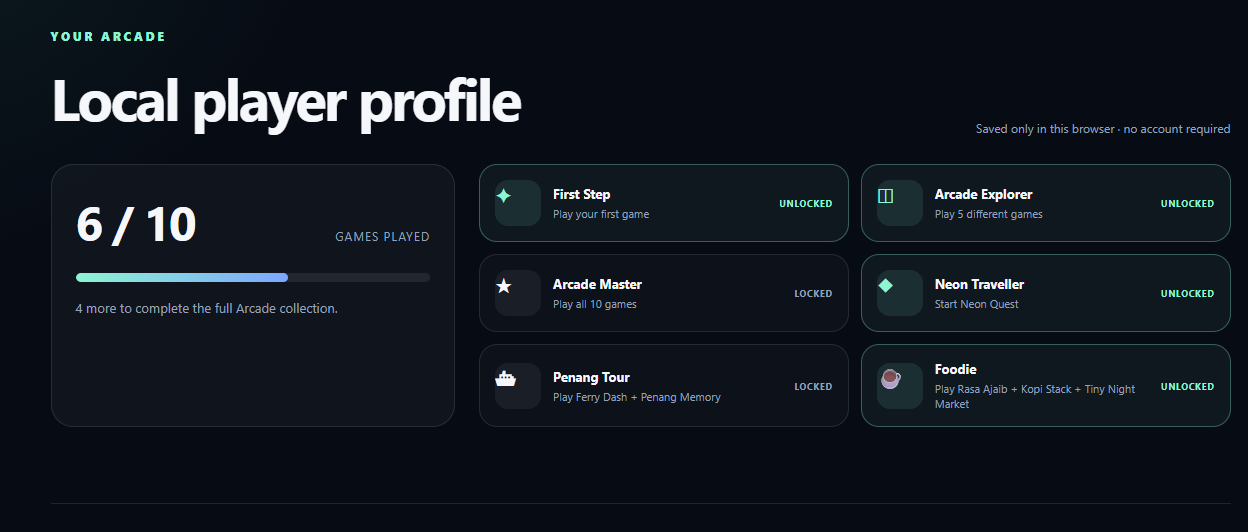
Using localStorage is a practical compromise. It works well for small progress markers and preferences, but the data belongs to that browser. If a player changes device or clears browser storage, the profile does not behave like a cloud-synchronised account. For this project, that limitation is acceptable because the priority is fast access rather than account infrastructure.
Desktop and mobile both matter
Browser games are easy to open on a phone, but that does not automatically make them pleasant to play. Keyboard controls that feel natural on desktop may need touch buttons, dragging or simplified interaction on mobile. That means responsiveness is not only a layout problem; it is also an input-design problem.
As the collection grew, I started treating the Arcade itself as a product. The questions became broader: how should players return to the Arcade, how should new games be introduced, how much progress should be shared, and how do I keep the interface from becoming a wall of links?
What I learned from building a collection
Building several small games creates a different set of problems from building one title. A single game can have its own interface and controls. A collection needs consistency. Navigation, naming, visual identity, responsive behaviour and discovery become part of the development work.
That is why WynnWorld Arcade is useful to me beyond the games themselves. It is a continuing exercise in product thinking: build something small, test it, notice friction, improve the shared structure and then apply those lessons to the next project.
What comes next
The Arcade will continue to evolve through shared navigation, mobile improvements, game polish and better discovery. The next build note looks at the deployment side: how Phaser and Vite projects are packaged so they can live reliably under Cloudflare Pages and subfolder URLs.