Creating Penang Retro Mandopop: From Place Memory to Visual Music
The Penang music projects work best when the nostalgia is specific: real local images, controlled musical direction and repeated visual refinement.
Why Penang became part of the music
When I started creating nostalgic Mandarin lo-fi and retro-pop projects, I did not want the visuals to feel like a generic "Asian vintage" background. Penang gave the work a more specific emotional setting: old ferries, five-foot ways, kopitiam scenes, rain, George Town streets and memories of an earlier pace of life.
This direction also reflects my own transition after a long corporate career. Learning AI music and visual tools gave me a way to build creative work from places and moods I already knew instead of copying a style with no personal connection.
Chloe Ooi as a recurring music identity
Chloe Ooi became the recurring artist identity for the Mandarin lo-fi and unplugged side of Wynn Ng Studio. Keeping a consistent identity helps different songs feel like parts of one world rather than isolated experiments.
The music direction generally stays away from high-pitched vocals, long sustained notes, heavy electronic production and rap. I prefer a natural mid-range vocal, softer rock or unplugged textures, and choruses that remain easy to sing.
From single songs to a 37-minute mix
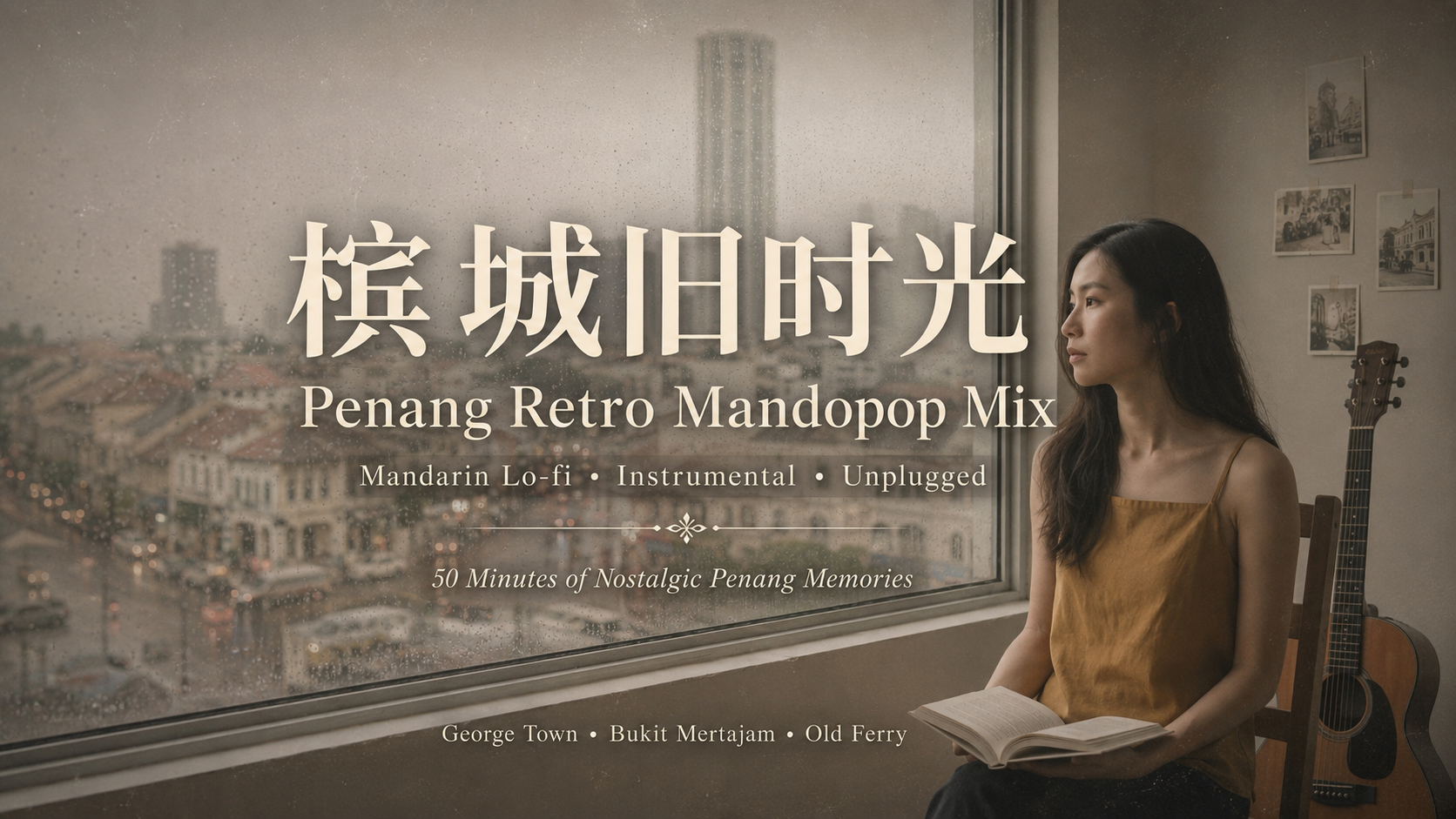
槟城旧时光 developed into a longer retro Mandopop mix rather than a single standalone track. The finished 37-minute video combined vocal, instrumental and unplugged variations across eight song sections.
The longer format changed the production problem. A single music video can rely on one main story, but a mix needs enough visual continuity to feel coherent across several songs without pretending every track is the same scene.
Specific places create stronger memories
Another song, 迎风的旧渡轮, used the ferry as a recurring image. The video moved between the ferry, a driver and a woman while keeping the Penang setting central. 雨后的五脚基 took a different memory—the covered five-foot way after rain—and turned it into a quieter visual story.
The useful lesson was that specificity improves the creative work. "A nostalgic city" is vague. A ferry, a five-foot way, wet pavement or an old street gives both the image generation and the storytelling something concrete to hold onto.
AI tools still need direction
Using AI does not remove the need for taste. Generated visuals can easily become overly polished, inconsistent or disconnected from one shot to the next. I spend time reducing those problems: choosing a consistent period feeling, avoiding modern brand clutter, controlling camera movement and deciding which scenes deserve to repeat.
The same applies to music. A generated track may technically fit the prompt but still have the wrong vocal range, too much humming, overlong sustained notes or drums that dominate the arrangement. Iteration is where the project becomes mine.
What I learned from the Penang series
The strongest part of the project is not simply "AI music." It is the combination of personal place memory, Mandarin songwriting, visual continuity and repeated refinement. Penang gives the series a centre of gravity, while the tools provide a way to explore it quickly.
That is the direction I want WynnWorld to document: not only the finished upload, but why a certain place, sound or visual choice was used and what changed before publishing.